


Joseph KOSUTH wurde 1945 in Toledo, Ohio (USA), geboren. Er studierte von 1963 bis 1964 am Cleveland Institute of Art, von 1965 bis 1967 an der School of Visual Arts in New York sowie von 1971 bis 1972 Anthropologie und Philosophie an der New School for Social Research (New York). Er lebt und arbeitet in New York und Rom.
Joseph KOSUTH zählt zu den bedeutendsten Pionieren der Konzept- und Installationskunst. Bereits in den 1960er-Jahren entwickelte er sprachbasierte Arbeiten und Strategien der Aneignung, mit denen er die traditionellen Vorstellungen von Kunst und künstlerischer Autorschaft grundlegend hinterfragte. Im Zentrum seiner Praxis stehen die Produktion von Bedeutung sowie das Verhältnis von Sprache, Wissen und Kunst. Sein Werk ist von fortwährenden Transformationsprozessen geprägt, in denen Literatur zu Material, Material zu Kunst und Kunst zur philosophischen Befragung wird. „Bei der Herstellung von Bedeutung (welche ebenso das Auslöschen oder die Aneignung schon bestehender Bedeutung beinhaltet) hat der Künstler die Freiheit, alles zu verwenden, was schon in der Welt vorhanden ist.“ (zit. nach Thomas Miessgang, Wien 2023)
Mit seinem Schlüsselwerk One and Three Chairs (1965), das einen Stuhl, dessen fotografische Abbildung und eine Wörterbuchdefinition miteinander verbindet, formulierte KOSUTH grundlegende Fragen nach Repräsentation, Wahrnehmung und Bedeutung. Seine künstlerische Praxis, die unter anderem Textarbeiten, Neoninstallationen und ortsspezifische Interventionen umfasst, ist eng mit sprachphilosophischen Überlegungen verbunden, insbesondere mit dem Denken Ludwig Wittgensteins.
Joseph KOSUTHs Arbeiten wurden international in zahlreichen Einzelausstellungen gezeigt, darunter Museum of Modern Art PS1 (New York), Sigmund Freud Museum (Wien), Palais des Beaux-Arts (Brüssel), Isabella Stewart Gardner Museum (Boston), Schirn Kunsthalle (Frankfurt), Musée du Louvre (Paris), Australian Centre for Contemporary Art (Melbourne), Museum Haus Konstruktiv (Zürich), The Jewish Museum (New York), Kunstmuseum Thurgau (Warth), Multimedia Art Museum (Moskau), Kunstmuseum Stuttgart sowie Casa dei Tre Oci – Berggruen Institute Europe (Venedig). 2023 präsentierte die Christine König Galerie (Wien) seine Ausstellung Korrektur (Uncorrected), in der sich KOSUTH mit dem Werk des österreichischen Schriftstellers Thomas Bernhard auseinandersetzte.
Darüber hinaus nahm KOSUTH mehrfach an bedeutenden internationalen Großausstellungen teil, darunter documenta 5, 6, 7 und 9 (Kassel) sowie die Biennale di Venezia 1976, 1993, 1999 und 2007. Für seine künstlerische Arbeit erhielt er zahlreiche Auszeichnungen, darunter Brandeis Award (1990), Menzione d’Onore der Biennale di Venezia (1993), den französischen Orden Chevalier de l’Ordre des Arts et des Lettres (1993) sowie das Große Goldene Ehrenzeichen für Verdienste um die Republik Österreich (2003).
Seine Arbeiten befinden sich in bedeutenden öffentlichen und privaten Sammlungen, darunter Museum of Modern Art (New York), Solomon R. Guggenheim Museum (New York), Whitney Museum of American Art (New York), National Gallery of Art (Washington, D.C.), Hirshhorn Museum and Sculpture Garden (Washington, D.C.), Museum of Contemporary Art (Los Angeles), San Francisco Museum of Modern Art, Centre Pompidou (Paris), Tate (London), mumok – Museum moderner Kunst Stiftung Ludwig Wien, M HKA (Antwerpen), Stedelijk Museum (Amsterdam), Moderna Museet (Stockholm), Museum of Contemporary Art Kiasma (Helsinki), Fondation Cartier pour l’art contemporain (Paris), Kunstmuseum Stuttgart sowie 21st Century Museum of Contemporary Art (Kanazawa).
– – –
Joseph KOSUTH was born in 1945 in Toledo, Ohio (USA). He studied at the Cleveland Institute of Art from 1963 to 1964, at the School of Visual Arts in New York from 1965 to 1967, and anthropology and philosophy at the New School for Social Research (New York) from 1971 to 1972. He lives and works in New York and Rome.
Joseph KOSUTH is considered one of the most influential pioneers of Conceptual and Installation Art. As early as the 1960s, he developed language-based works and strategies of appropriation that fundamentally challenged traditional notions of art and artistic authorship. His practice centres on the production of meaning and the relationship between language, knowledge, and art. His work is characterised by continuous processes of transformation, in which literature becomes material, material becomes art, and art becomes philosophical inquiry. “With the creation of meaning (which equally implies the extinction or the appropriation of already existing meaning), the artist has the freedom to use everything that is already available in the world.” (Thomas Miessgang, Vienna 2023, translated by Sarah Cormack)
With his seminal work One and Three Chairs (1965), which brings together a chair, its photographic representation, and a dictionary definition, KOSUTH raised fundamental questions concerning representation, perception, and meaning. His artistic practice, encompassing text-based works, neon installations, and site-specific interventions, is closely connected to philosophical investigations of language, particularly the thinking of Ludwig Wittgenstein.
Joseph KOSUTH’s works have been presented internationally in numerous solo exhibitions, including MoMA PS1 (New York), Sigmund Freud Museum (Vienna), Palais des Beaux-Arts (Brussels), Isabella Stewart Gardner Museum (Boston), Schirn Kunsthalle (Frankfurt), Musée du Louvre (Paris), Australian Centre for Contemporary Art (Melbourne), Museum Haus Konstruktiv (Zurich), The Jewish Museum (New York), Kunstmuseum Thurgau (Warth), Multimedia Art Museum (Moscow), Kunstmuseum Stuttgart, and Casa dei Tre Oci – Berggruen Institute Europe (Venice). In 2023, Christine König Galerie (Vienna) presented his exhibition Korrektur (Uncorrected), in which KOSUTH engaged with the work of Austrian writer Thomas Bernhard.
KOSUTH has also participated in major international exhibitions, including documenta 5, 6, 7, and 9 (Kassel), as well as the Venice Biennale in 1976, 1993, 1999, and 2007. He has received numerous awards and honours for his artistic achievements, including the Brandeis Award (1990), the Menzione d’Onore at the Venice Biennale (1993), the French distinction Chevalier de l’Ordre des Arts et des Lettres (1993), and the Grand Decoration of Honour in Gold for Services to the Republic of Austria (2003).
His works are held in major public and private collections, including Museum of Modern Art (New York), Solomon R. Guggenheim Museum (New York), Whitney Museum of American Art (New York), National Gallery of Art (Washington, D.C.), Hirshhorn Museum and Sculpture Garden (Washington, D.C.), Museum of Contemporary Art (Los Angeles), San Francisco Museum of Modern Art, Centre Pompidou (Paris), Tate (London), mumok – Museum moderner Kunst Stiftung Ludwig Wien, M HKA (Antwerp), Stedelijk Museum (Amsterdam), Moderna Museet (Stockholm), Museum of Contemporary Art Kiasma (Helsinki), Fondation Cartier pour l’art contemporain (Paris), Kunstmuseum Stuttgart, and 21st Century Museum of Contemporary Art (Kanazawa).
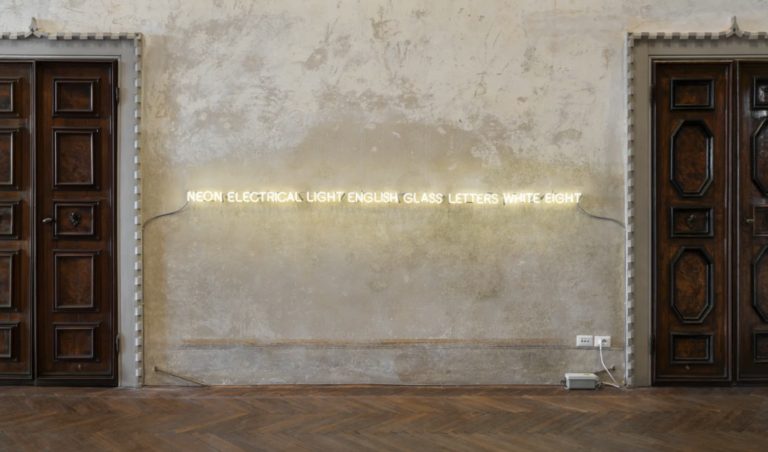
Berggruen Institute Europe, Casa dei Tre Oci, Venice

Kunstmuseum Stuttgart

Honoris Causa Diploma, Accademia Albertina di Belle Arti di Torino, Turin, Italy

Sprüth Magers, London

Kursalon, Vienna

IMMA - Irish Museum of Modern Art, Dublin

ifa Gallery, Stuttgart

Published by:
Christine König Galerie, Vienna, 2023
please email us at office@christinekoeniggalerie.at
to purchase the catalogue!


