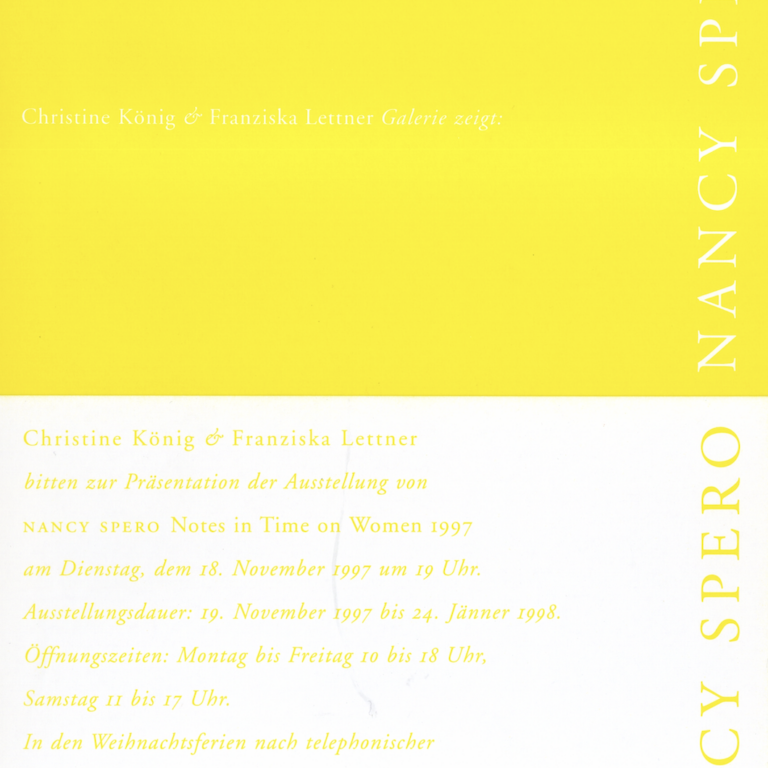
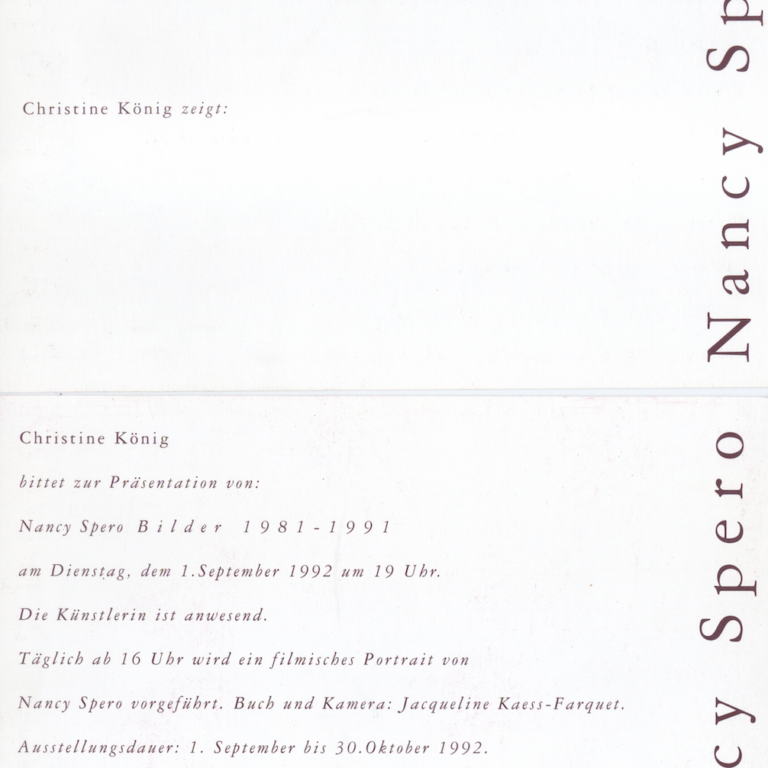
Nancy SPERO wurde 1926 in Cleveland, Ohio, (USA) geboren und starb 2009 in New York. Sie studierte von 1945 bis 1949 am Art Institute of Chicago und von 1949 bis 1950 an der École des Beaux-Arts in Paris.
Nancy SPERO benutzte Bilder von Frauen aus verschiedenen Epochen und Kulturen, die sie als Prototypen in ihre Collagen einfügt. Sie löst diese aus ihrem ursprünglichen Kontext und setzt sie in neue Zusammenhänge. Für Nancy SPERO, die seit 1972 ausschließlich Frauen darstellt, ist die Weltgeschichte eine Geschichte der Kriege und damit auch eine Geschichte der Frauen, eine Geschichte von Opfer und Überleben. Seit 1968 war sie politisch engagiert in der amerikanischen Frauenbewegung. 1971 war sie Gründungsmitglied von A.I.R., der ersten kooperativen Kunstgalerie für und von Frauen in New York. In den 1970er-Jahren entstanden politische, feministische Werke wie die „War Series“ (über Gewalt und männliche Sexualität), „Torture of Women“ (über die Geschichte der Folter weiblicher Gefangener in Lateinamerika) oder „Notes in Time on Women“ (Frauen als Protagonistinnen der Kulturgeschichte).
Nancy SPEROs Werke wurden in Einzelausstellungen gezeigt, unter anderem in der Galerie Lelong (New York), Louisiana Museum of Modern Art (Humlebaek), Museum Folkwang (Essen), MoMA PS1 (New York), Museo Tamayo (Mexiko-City), Serpentine Gallery (London), Centre Pompidou (Paris), Museum der Moderne (Salzburg), Frac Haute-Normandie, Vancouver Art Gallery, Hiroshima City Museum of Contemporary Art, MIT List Visual Arts Center (Massachusetts), Malmö Konsthall, National Gallery of Canada (Ottawa), Museum Villa Stuck (München). Zudem nahm sie an der Sydney-, Venedig-, Whitney-, Gwangju- und São Paulo Biennale teil.
Nancy SPERO wurde 1996 mit dem Hiroshima Art Prize ausgezeichnet.
Permanente Wandfresken von Nancy SPERO entstanden in der U-Bahn-Station Lincoln Center in New York, im MoCA (Los Angeles), im Festspielhaus Hellerau (Dresden), in der Schirn Kunsthalle (Frankfurt) sowie drei in Österreich: im Ronacher Theater Wien, im Jüdischen Museum Wien und in der Conradkaserne Innsbruck.
Ihre Werke befinden sich in Sammlungen wie der Art Gallery of Ontario (Toronto), Art Institute of Chicago, Berkeley Art Museum, Brooklyn Museum, Centro Cultural Mexiko-City, Cleveland Museum of Art, Dallas Museum of Art, Frac Nord Pas de Calais, Greenville County Museum of Art, Harvard University Art Museums (Massachusetts), Hiroshima City Museum of Contemporary Art, ICA (Boston), Jewish Museum (New York), Kunstmuseum Düsseldorf, MIT List Visual Arts Center (Massachusetts), Musée des Beaux-Arts de Montréal, Centre Pompidou (Paris), Reina Sofía (Madrid), MoMA (New York), National Gallery of Art (Washington), National Gallery of Australia (Canberra), National Gallery of Canada (Ottawa), Pérez Art Museum Miami, Philadelphia Museum of Art, Remai Modern (Saskatoon), Smithsonian American Art Museum, TATE (London), Toledo Museum of Art, Uffizien (Florenz), Vancouver Art Gallery, Wakefield City Art Gallery (Yorkshire) und Whitney Museum of American Art (New York).
–
Nancy SPERO was born in 1926 in Cleveland, Ohio (USA), and died in 2009 in New York. She studied at the Art Institute of Chicago from 1945 to 1949 and at the École des Beaux-Arts in Paris from 1949 to 1950.
Nancy SPERO used images of women from different historical periods and cultures, incorporating them as prototypes into her collages. She removed these figures from their original contexts and placed them in new constellations. For Nancy SPERO, who exclusively depicted women from 1972 onwards, world history was a history of wars and thus also a history of women—a history of victimhood and survival. From 1968 onwards, she was politically active in the American women’s movement. In 1971, she was a founding member of A.I.R., the first cooperative art gallery for and by women in New York. During the 1970s, she created political and feminist works such as the “War Series” (addressing violence and male sexuality), “Torture of Women” (dealing with the history of the torture of female prisoners in Latin America), and “Notes in Time on Women” (presenting women as protagonists of cultural history).
Nancy SPERO’s works have been shown in solo exhibitions, including at Galerie Lelong (New York), Louisiana Museum of Modern Art (Humlebæk), Museum Folkwang (Essen), MoMA PS1 (New York), Museo Tamayo (Mexico City), Serpentine Gallery (London), Centre Pompidou (Paris), Museum der Moderne (Salzburg), Frac Haute-Normandie, Vancouver Art Gallery, Hiroshima City Museum of Contemporary Art, MIT List Visual Arts Center (Massachusetts), Malmö Konsthall, National Gallery of Canada (Ottawa), and Museum Villa Stuck (Munich). She also participated in the Sydney Biennale, Venice Biennale, Whitney Biennial, Gwangju Biennale, and São Paulo Biennial.
Nancy SPERO was awarded the Hiroshima Art Prize in 1996.
Permanent wall works by Nancy SPERO were created for the Lincoln Center subway station in New York, MoCA (Los Angeles), Festspielhaus Hellerau (Dresden), and Schirn Kunsthalle (Frankfurt), as well as three locations in Austria: Ronacher Theater (Vienna), Jewish Museum Vienna, and Conradkaserne (Innsbruck).
Her works are held in collections such as Art Gallery of Ontario (Toronto), Art Institute of Chicago, Berkeley Art Museum, Brooklyn Museum, Centro Cultural (Mexico City), Cleveland Museum of Art, Dallas Museum of Art, Frac Nord-Pas de Calais, Greenville County Museum of Art, Harvard University Art Museums (Massachusetts), Hiroshima City Museum of Contemporary Art, ICA (Boston), Jewish Museum (New York), Kunstmuseum Düsseldorf, MIT List Visual Arts Center (Massachusetts), Musée des Beaux-Arts de Montréal, Centre Pompidou (Paris), Museo Reina Sofía (Madrid), MoMA (New York), National Gallery of Art (Washington), National Gallery of Australia (Canberra), National Gallery of Canada (Ottawa), Pérez Art Museum Miami, Philadelphia Museum of Art, Remai Modern (Saskatoon), Smithsonian American Art Museum, TATE (London), Toledo Museum of Art, Uffizi Galleries (Florence), Vancouver Art Gallery, Wakefield City Art Gallery (Yorkshire), and Whitney Museum of American Art (New York).